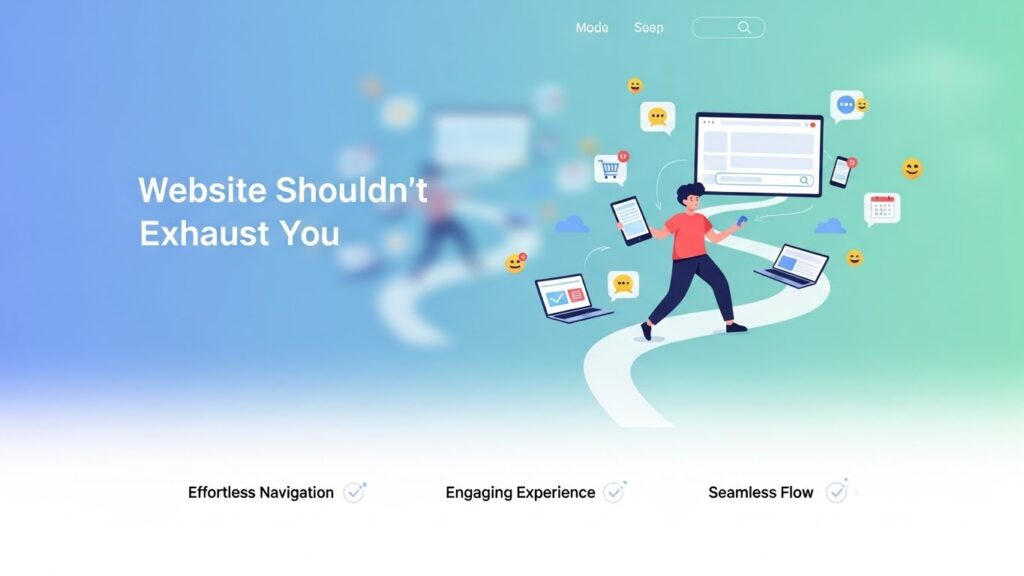
Many small business owners secretly dread their website. Not because they don’t care, but because every update feels like wading through mud. If that’s you, here’s the truth: your website shouldn’t require constant mental energy. When it does, that’s a design issue, not a personal failing.
A well-structured website is like a thoughtful host. It welcomes visitors, guides them where they need to go, and answers key questions before they need to ask. When your site is confusing or cluttered, it puts work on both you and your audience. Visitors have to dig for information. You have to over-explain in emails, DMs, or phone calls.
If updating your site feels heavy, start by checking whether these basics are clear:
-
What do you do, and who is it for? If visitors can’t answer that within a few seconds of landing on your homepage, they’ll either leave—or you’ll keep getting “Do you also do…?” messages that drain your time.
-
What’s the next step? Is there a simple, visible path for people who are interested? That might be “Book a call,” “Fill out this form,” or “View services,” but it must be obvious.
-
What questions are you answering upfront? Think about the things you explain over and over again. Your site can handle some of that explaining for you.
For neurodivergent business owners or anyone with limited energy, the website should be a quiet teammate that takes work off your plate. That might mean:
-
Creating one “Start Here” page that gathers your most important information in one place.
-
Using short sections and headings instead of long, dense paragraphs, so both you and your readers can scan quickly.
-
Building a simple structure (Home → Services → About → Contact) instead of chasing trends that don’t match your business.
AI tools can support this without taking over your voice. You can feed them your rough notes, existing copy, or even voice transcriptions and ask for:
-
Shorter, clearer versions of what you already say.
-
Bullet-point summaries of key services that you can then refine.
-
FAQ lists based on customer questions you’ve been collecting.
The magic happens when your lived experience and your understanding of your clients guide the structure, and AI helps you shape the words into something easier to maintain.
Your website is not meant to be a museum of everything you’ve ever done. It’s meant to be a working tool that reduces friction for your right people—and for you. If your site currently feels like a weight, that’s a signal, not a verdict. With the right structure and support, it can become one of the calmest, most reliable parts of your business.