If every client project feels like starting from scratch, your offers are costing you more energy than you think.
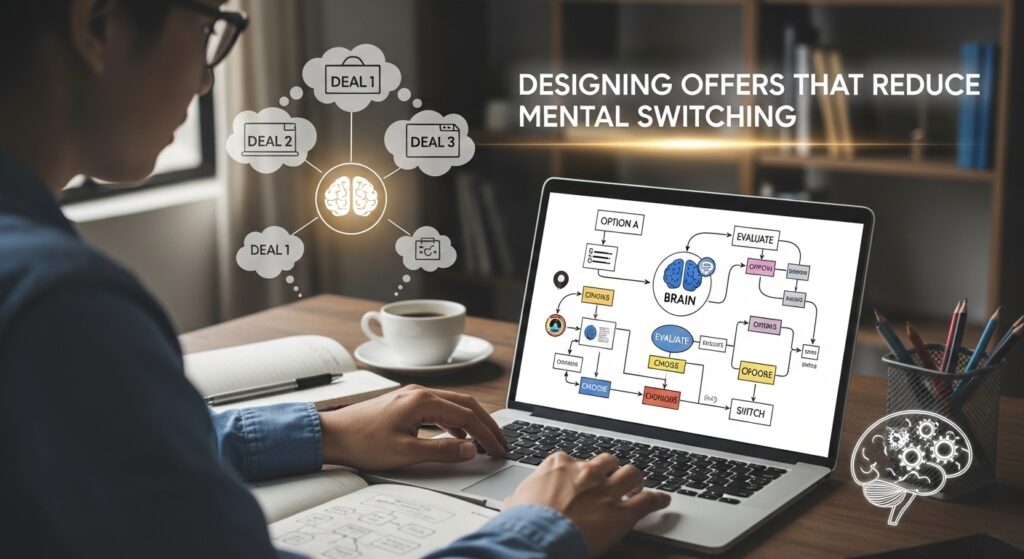
For neurodivergent entrepreneurs and overwhelmed business owners, the enemy isn’t just “too much work.” It’s mental switching—jumping between different types of tasks, thinking styles, and expectations all day long.
The good news? You can design your offers to reduce mental switching—and protect your brain.
What Mental Switching Really Looks Like
Mental switching is when your day looks like this:
- Answer a detailed strategy question
- Jump into Canva to design something
- Switch to writing website copy
- Answer a “quick” tech question
- Change gears again to send an invoice
Each switch has a cost. Your brain has to:
- Remember where you left off
- Rebuild context
- Shift into a different kind of thinking
Do that 20 times a day, and no wonder you’re exhausted.
Offer Design as Cognitive Accessibility
Most people design offers around “What will sell?”
I want you to also ask: “What can I sustainably deliver with my brain and life?”
Accessible offers:
- Use similar delivery steps across clients
- Stay within a defined set of skills
- Minimize context-switching inside a single package
- Have clear boundaries about what’s not included
That’s not “limiting yourself.” It’s reducing friction so you can do your best work.
Step 1: List Your Current Services
Write down everything you currently say yes to:
- Website design
- Google Business Profile setup
- Random tech help
- Content editing
- Strategy calls
- Fix-this-one-thing favors
Then ask: Which of these require very different kinds of brain states?
Those are your mental-switching red flags.
Step 2: Group Services by Energy + Thinking Style
You might notice natural clusters, like:
- Strategic thinking: audits, consulting, planning
- Build/implementation: website builds, GBP setups, automations
- Maintenance/support: updates, content tweaks, check-ins
Instead of stuffing all three into every offer, try building offers around fewer modes.
Example:
- Strategy-only offer
- Build-only offer with a simple plan
- Maintenance-only retainer
You can still bundle them—but you’re doing it intentionally.
Step 3: Define “Standard Inclusions”
For each offer, decide:
- What’s always included
- What’s never included
- What’s available as an add-on
This reduces in-the-moment decisions and protects your energy.
Example – Website Reset:
- Always: up to 5 pages, basic SEO, mobile optimization
- Never: full branding, custom illustration, complex integrations
- Add-ons: extra pages, blog migration, advanced automations
Now you’re not deciding from scratch each time—you’re referencing a system.
Step 4: Build a Delivery Checklist
For each offer, outline the delivery steps:
- Kickoff call
- Collect content
- Build draft
- Review and revise
- Launch and handoff
On low-energy days, you don’t have to figure out what to do—you just follow the checklist.
A Real Offer Redesign Example
A client once offered “whatever you need” digital services. Her brain was switching all day long.
We:
- Cut her services down to 3 core offers
- Grouped work by type (strategy, build, support)
- Created one delivery checklist per offer
Her comment: “I feel less scattered—and clients actually understand what I do now.”
You’re Allowed to Design for Your Brain
Designing offers that reduce mental switching isn’t selfish. It’s:
- Better for your clients (clearer expectations)
- Better for your nervous system (less chaos)
- Better for your business (more consistency and capacity)
You’re not being “picky.” You’re being sustainable.