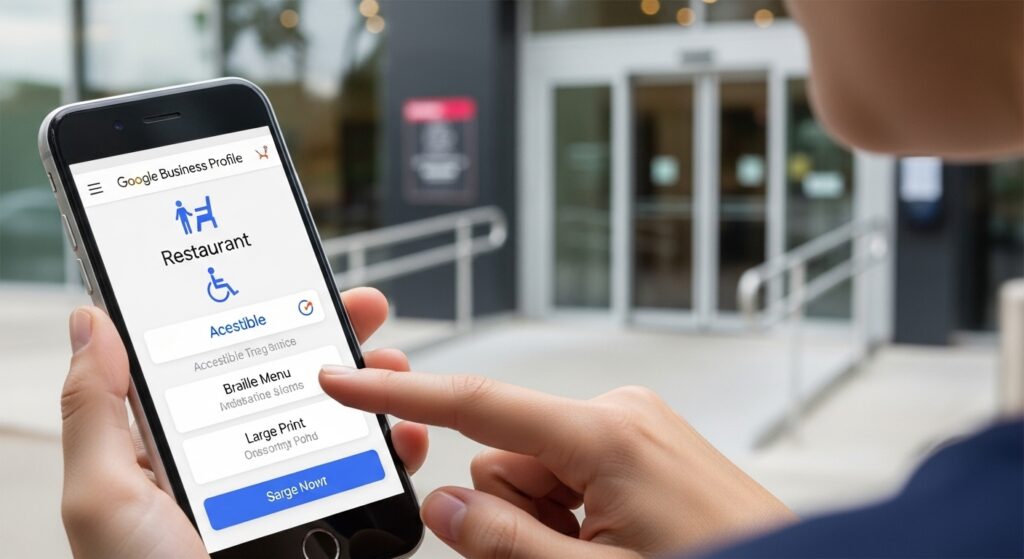
Most people see Google Business Profile as a marketing tool. I want you to see it as something deeper: an accessibility tool—for you and for your clients.
When you're neurodivergent, caregiving, managing chronic illness, or simply stretched thin, your business needs ways to communicate clearly and consistently without you having to be “on” all the time. GBP can quietly carry a lot of that load.
Accessibility for You: Reducing Cognitive Load
Every time a potential client has to ask you basic questions, your brain has to:
- Switch tasks.
- Find the information.
- Answer in a clear, friendly way.
Doing that once is fine. Doing it 50 times a month is executive function drain.
A well-structured GBP can answer a huge percentage of those questions before they get to your inbox:
- What do you do?
- Where are you located?
- When are you open?
- How do they contact you?
- What do other people think of your work?
That means:
- Fewer repetitive emails.
- Fewer “sorry for the delay” messages.
- More of your limited cognitive energy reserved for actual work.
Accessibility for Clients: Clear, Centralized Information
For your clients—especially disabled, neurodivergent, or overwhelmed ones—scattered information is a barrier.
A good GBP listing puts everything in one place:
- Address, phone, website.
- Hours and service areas.
- Photos of your space (so they know what to expect).
- Clear service descriptions.
- Reviews that help them decide.
That's not just convenient. It's respectful.
Making GBP More Accessible (Step by Step)
1. Write a Sensory-Friendly Description
Avoid jargon. Focus on clarity and tone.
Example:
“I help small, service-based businesses create websites and systems that are easy to navigate, easy to maintain, and designed for real-life energy levels. I specialize in working with neurodivergent entrepreneurs, veteran-owned businesses, and busy parents in [your city].”
This tells people:
- Who you serve.
- What you do.
- How you approach it.
2. Use Photos to Reduce Uncertainty
Upload pictures that:
- Show your workspace (even if it's a home office).
- Show you (so they know who they'll meet).
- Show examples of your work (screenshots, before/after, etc.).
For anxious or neurodivergent clients, reducing unknowns makes it easier to reach out.
3. Make Your Hours and Contact Options Clear
If you don't respond on weekends, say so.
If you prefer email over phone calls, say that too.
Accessible communication means:
- Clients know when to expect a reply.
- You're not pushing yourself to be “on” 24/7.
4. Use the Q&A Section Proactively
Instead of waiting for questions, seed the Q&A with things you hear all the time:
- “Do you work with people outside [city]?”
- “Do you offer payment plans?”
- “Are you available evenings or weekends?”
- “Do you work well with neurodivergent clients?”
Post the questions and answer them yourself. It's like a mini FAQ living right in Google Search.
A Quiet System That Works While You Rest
Once your GBP is set up well, it does a lot of heavy lifting:
- New people can understand your services without a long call.
- Returning clients can find your number, hours, or website quickly.
- People who are nervous about reaching out can “preview” you first.
You don't have to be constantly visible to be findable.
A Client Story
A therapist who serves neurodivergent adults came to me feeling invisible and drained by social media. We:
- Rewrote her GBP description in plain, reassuring language.
- Added interior photos of her office so new clients knew what to expect.
- Clarified that she offers telehealth and made her hours crystal clear.
- Seeded her Q&A with “Do you work with ADHD?” and “Do you offer virtual sessions?”
Her inquiries went up, her no-shows went down, and—most importantly—her clients told her, “Your listing made it feel safer to reach out.”
Marketing and Accessibility Can Be the Same Thing
You don't have to choose between “good marketing” and “accessible systems.” When done well, they are the same work.
Google Business Profile is one of the simplest ways to make your business easier to approach for you and for the people you serve.