Some days in an international move are about figuring out basic things—transportation, paperwork, where to buy everyday items. Other days are about serving clients like nothing changed. The only reason you can hold both realities at once is that your business isn’t built on constant improvisation. It’s built on systems that hold the details so your brain can focus on adjusting.
This is the difference between hustle-built businesses and capacity-first businesses. Hustle-built businesses assume you’ll always be available, always be online, always be sharp. Capacity-first businesses assume that life will interrupt—and design for that from the beginning.
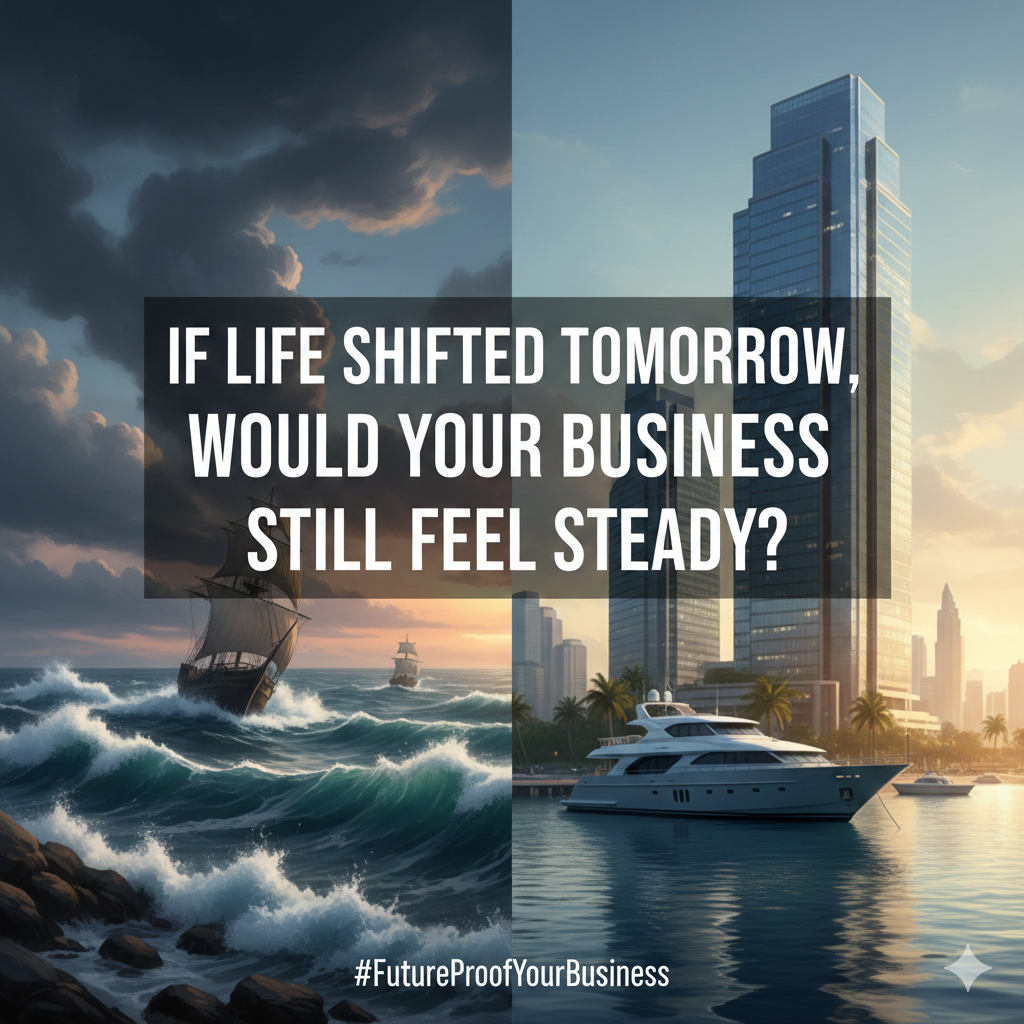
If your life shifted tomorrow, would your business still feel steady? That question can feel scary, but it’s actually an invitation. It highlights exactly where systems could support you more.
Start by looking at three areas:
- Communication
- Do clients know how and when they can reach you?
- Do you have standard email templates for common situations—onboarding, updates, delays, boundaries?
- Could AI help you draft these templates so you’re not starting from scratch every time?
- Delivery
- Are your services and deliverables clearly defined, or are you reinventing the process with each client?
- Is there a checklist or workflow you can follow even when your brain is tired or your schedule is disrupted?
- Could you use AI to outline your delivery process and then turn that into a simple project checklist?
- Visibility
- Is your website up to date enough that someone could understand what you do without a live conversation?
- Is your Google Business Profile accurate, so local clients or collaborators can still find you while you adjust your day-to-day life?
- Could you batch some content ideas and let AI turn them into posts you can use over a few weeks?
The goal is not to make your business “transition-proof.” Life will always bring surprises. The goal is to reduce the number of things that fall apart when your attention is pulled somewhere important—like your health, your family, or your move.
For neurodivergent entrepreneurs and nonprofit leaders, this kind of planning is not pessimistic. It’s protective. It respects the reality that energy, focus, and capacity fluctuate, and it treats systems as a way of honoring that truth.
You deserve a business that can flex with your life, not one that collapses every time circumstances change. If some part of your work feels like it would crumble the moment you look away, that’s not a reason for shame—it’s a place to start redesigning.